
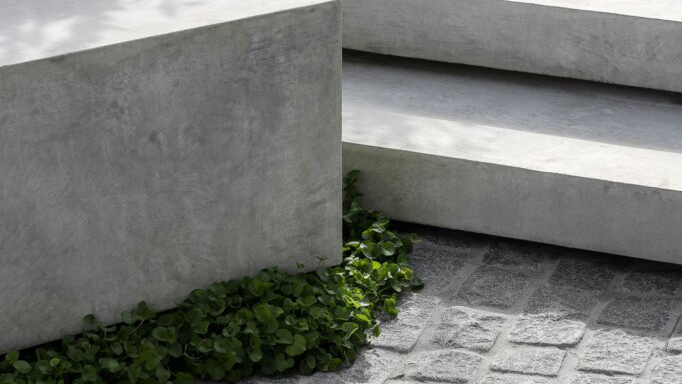
Concrete is one of the most widely used materials in the world, and in landscape architecture it has become a symbol of strength and permanence. Its robust presence can shape entire environments, from monumental plazas to the most intimate corners of a private garden. With its sober character and neutral tones, concrete offers a simplicity that highlights rather than overshadows the surrounding vegetation and architectural context.
In outdoor spaces, concrete plays a dual role: structural and expressive. Retaining walls, staircases, and pavements often rely on its resistance, while benches, planters, or sculptural details reveal its potential as an aesthetic material. Its plasticity allows designers to explore both geometric precision and fluid, organic forms, turning functional elements into focal points of the landscape.
One of concrete’s greatest qualities is its honesty. It does not pretend to be something else — it expresses itself directly through texture, surface, and mass. This makes it a favorite in minimalist landscape design, where the absence of ornament and the clarity of materials create an atmosphere of calm and balance. Smooth surfaces, exposed aggregates, or raw finishes each add their own character and tactility.
In cities, concrete is indispensable for plazas, promenades, and infrastructure, where its durability ensures decades of use. At the same time, in residential gardens, concrete can be warm and discreet, used for terraces, garden steps, or subtle borders. Combined with wood, glass, or greenery, it becomes part of harmonious and layered compositions.
Although often perceived as industrial, concrete can support sustainability when used responsibly. Its longevity reduces the need for frequent replacements, while new technologies allow for lighter formulations, recycled aggregates, or permeable surfaces that improve stormwater management. In this sense, concrete continues to evolve, aligning with the ecological values of contemporary landscape design.
Concrete is more than a background material — it is an architectural presence that speaks of strength, stability, and modern simplicity. In the hands of designers, it has the ability to shape both monumental urban spaces and delicate garden details, creating landscapes that feel at once robust and refined.
In landscape architecture, concrete remains a timeless ally: a material that unites clarity of design with the endurance of structure, ensuring that outdoor spaces can resist time while maintaining a contemporary aesthetic.
